SEAFDEC to Finalize Regional Guide and Principles on Sustainable Seaweed Industry
Posted October 15, 2026
The SEAFDEC PMU met to advance regional frameworks for a sustainable aquaculture Southeast Asia initiative. The project aims to develop practical, safe, and inclusive guidance that benefits both small-scale and commercial seaweed sectors.
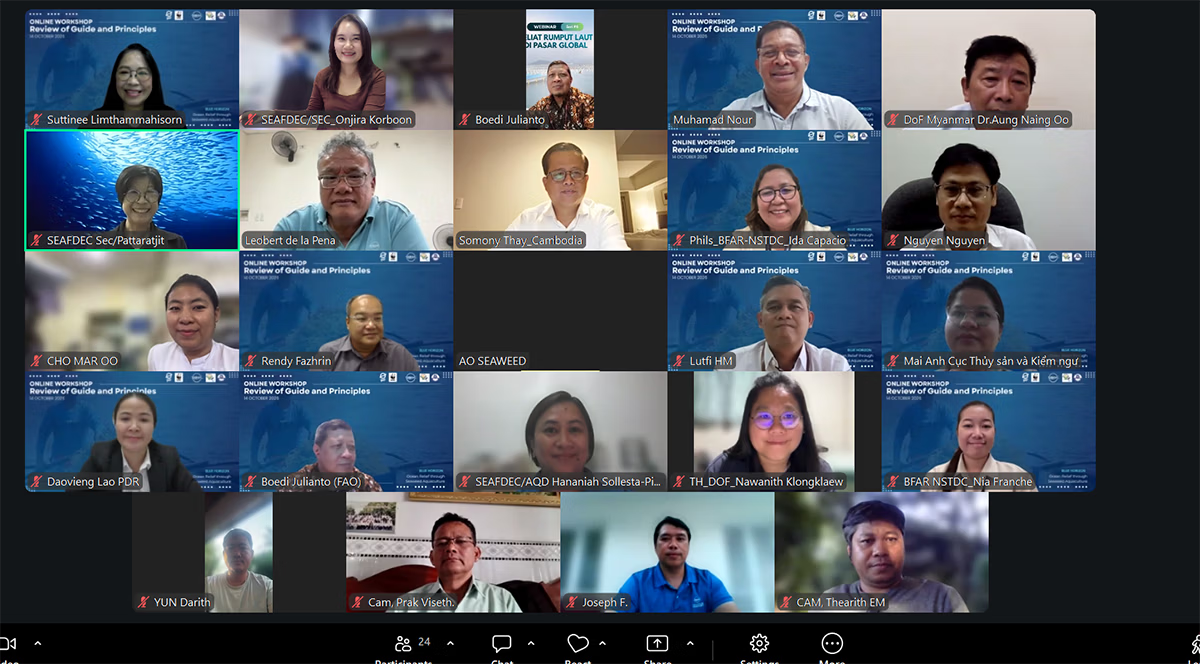
Bangkok, Thailand | The Southeast Asian Fisheries Development Center (SEAFDEC) Project Management Unit (PMU) convened a virtual Seaweed Technical Working Group (S-TWG) meeting on 14 October 2026 to advance the development of regional guidance for a sustainable, responsible, and safe seaweed industry in Southeast Asia.
The meeting built on technical work and stakeholder consultations under Output 1.1.2 and Output 1.1.3 of the Blue Horizon: Ocean Relief through Seaweed Aquaculture project. S-TWG members, SEAFDEC/AQD, national executing partners, and the Global Seaweed Coalition (GSC) reviewed the current drafts, identified technical and implementation gaps, and provided recommendations for further refinement. Seaweed experts from ASEAN Member States also shared national experiences and practical suggestions to ensure that the documents respond to diverse regional contexts.
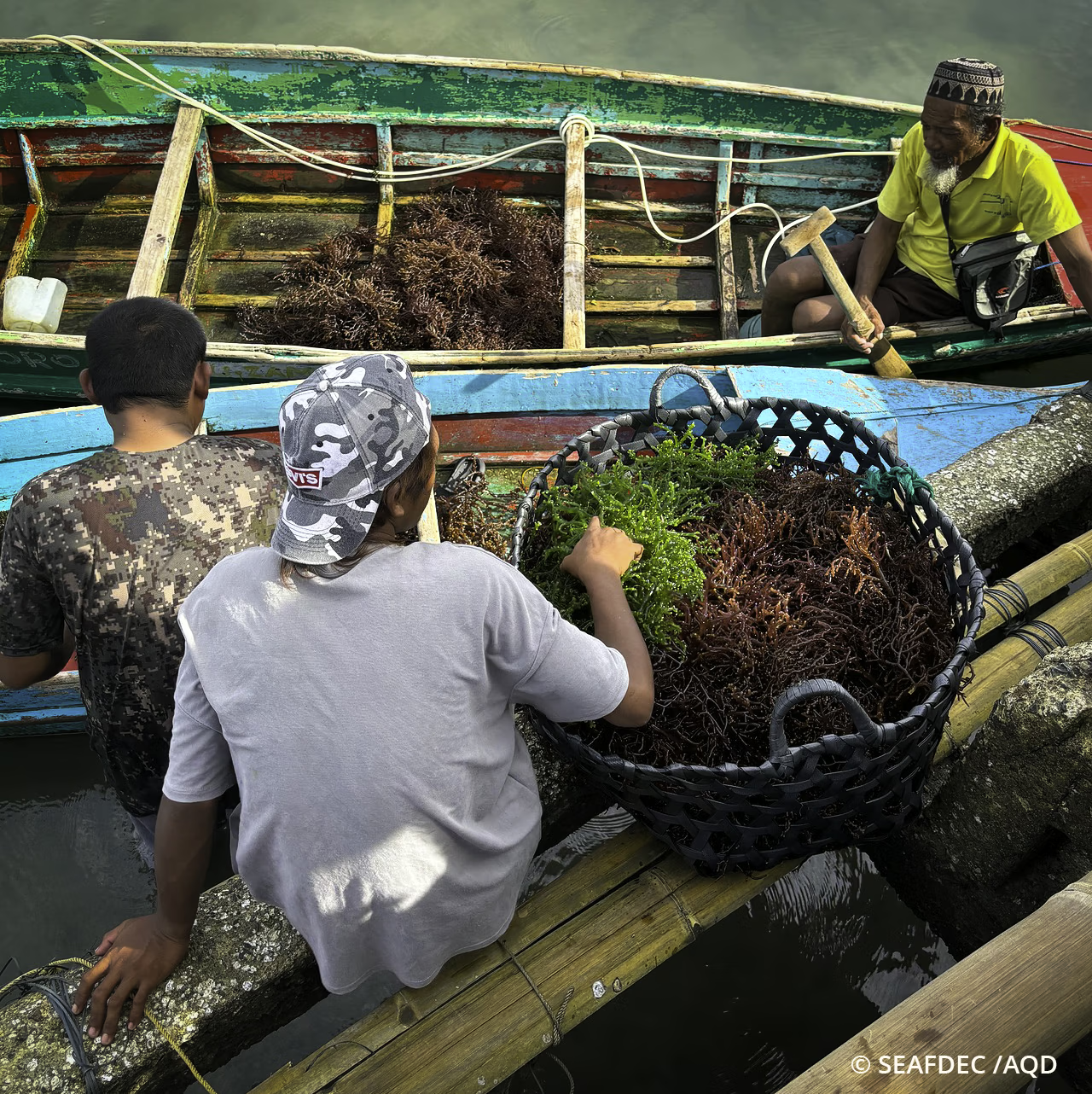
For Output 1.1.2, the Regional Guide for Sustainable Seaweed Industry, participants emphasized the need for practical guidance that can be applied by both small-scale farmers and larger cooperatives and companies. The Guide should provide different levels of guidance according to users’ capacities while maintaining consistency with the Regional Principles and Toolkit, particularly on implementation, monitoring, and gender equality. Participants also recommended including practical examples of integrated seaweed farming and value-added products, including linkages with tourism and other aquatic production systems.
Other priorities included establishing tissue culture laboratories and nurseries, improving product quality and food safety, increasing downstream value addition, protecting marine ecosystems, and reducing plastic waste from farming equipment.
For Output 1.1.3, the Regional Principles and accompanying Toolkit, participants called for clear, user-friendly, and visually engaging materials that provide practical guidance on farming, nursery management, and harvesting. The Toolkit should also promote women’s leadership by addressing access to assets, finance, training, and decision-making opportunities, rather than focusing solely on participation. Establishing testing laboratories for seaweed product safety and incorporating case studies from countries such as Thailand, Viet Nam, and Myanmar were also recommended.
Participants further highlighted the need to strengthen connections between small-scale farmers and downstream industries. Practical mechanisms that improve market linkages and enable farmers to participate more effectively in the value chain will be important for translating responsible and sustainable production into tangible economic benefits.
The meeting also highlighted the need to complement the regional documents with practical capacity development and implementation support. Myanmar noted that the Guide could be particularly useful as the country currently has no national standard for seaweed aquaculture, while Cambodia called for more hands-on and Training-of-Trainers (TOT) programs to create impact beyond the production of guidance documents. The meeting emphasized that the Guide and Principles should provide a common framework applicable to both small-scale and commercial sectors.
Following the meeting, S-TWG members will submit their consolidated comments and recommendations through the online feedback form by 22 October 2026. The consultants will use the inputs to revise the drafts ahead of the next in-person S-TWG meeting scheduled for 2–3 December 2026, which will further advance the documents toward finalization.
Through this collaborative process, SEAFDEC and its partners aim to establish practical regional guidance that supports an environmentally sustainable, economically viable, socially inclusive, responsible, and safe seaweed industry across Southeast Asia.
The Blue Horizon Seaweed Aquaculture is funded by Global Environment Facility (GEF) through WWF US as GEF Agency, executed by SEAFDEC PMU, BFAR – Bureau of Fisheries and Aquatic Resources of the Philippines, and DFiS – Department of Fisheries and Surveillance Viet Nam.